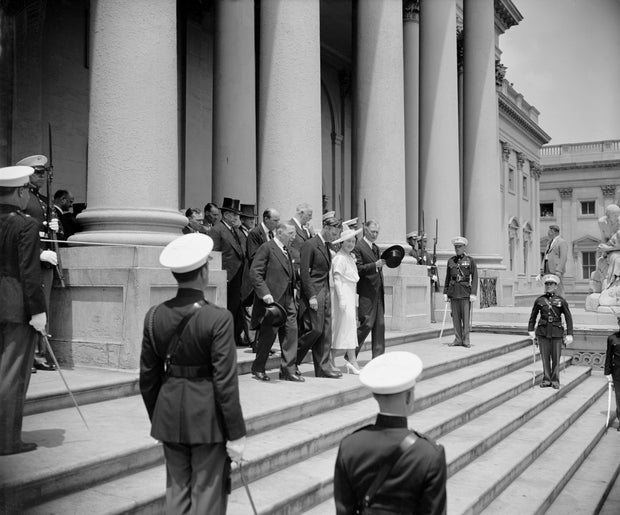
Photographs of British royals on American soil capture more than just ceremonial handshakes or dazzling gowns—they document the evolution of a complex, enduring alliance. As King Charles III embarks on a state visit to the United States, images from past royal tours resurface, offering a visual chronicle of diplomacy, public fascination, and cultural exchange. These moments, frozen in time, reflect not only the personal rapport between monarchs and presidents but also the shifting dynamics between two nations bound by language, history, and global influence.
This isn’t just about pageantry. Each royal visit has carried political weight, often timed to reinforce bilateral ties during pivotal moments—wars, anniversaries, or periods of diplomatic tension. And with every arrival, the cameras roll, the public gathers, and a new chapter is added to the visual record.
Let’s walk through that record—one photograph at a time.
The First Royal Footprint: King George VI and the 1939 Tour
No royal visit to the U.S. had occurred before 1939. The idea of a British monarch stepping onto American soil was almost unthinkable—until it wasn't.
Amid rising tensions in Europe, King George VI and Queen Elizabeth (later the Queen Mother) crossed the Atlantic in June 1939. Their mission: strengthen ties with the isolationist United States as war loomed in Europe. The images from that trip are striking—not for their glamour, but for their intimacy.
One iconic photo shows the royal couple eating hot dogs at a picnic hosted by President Franklin D. Roosevelt at his Hyde Park estate. The King, in a slightly ill-fitting suit, holds a frankfurter with polite uncertainty. It was a calculated gesture of relatability—a monarch embracing American informality.
“They wanted to show the King wasn’t just a symbol of empire, but a man who could sit on a porch and eat with the people,” notes historian Sarah Bradford.
Other photos from the trip depict massive crowds lining city streets in Washington, D.C., New York, and Chicago. The visit was a public relations triumph, softening American perceptions of the British monarchy and laying emotional groundwork for future alliance in World War II.
Queen Elizabeth II: The Reign of Diplomatic Images
No royal has visited the U.S. more than Queen Elizabeth II. Over seven decades, her trips produced some of the most enduring images in Anglo-American political history.
Her first official visit came in 1957, just four years into her reign. Photos show a young queen addressing a joint session of Congress—a rare honor—wearing a stunning orchid gown by Norman Hartnell. The image radiates both grace and authority, reinforcing her role as head of state in a post-imperial age.
But perhaps the most emotionally resonant images came during her 1976 trip, marking the U.S. bicentennial. Dressed in red, she sailed down the Hudson River aboard the Yamato, waving to millions. One photograph, taken from the deck of the HMS Bounty, captures her smiling broadly as fireworks explode behind her—an image of alliance and celebration in perfect sync.
:max_bytes(150000):strip_icc():focal(728x275:730x277)/princess-catherine-prince-william-donald-trump-king-charles-iii-trump-state-visit-uk-windsor-091725-8672599a27214b6f8ffdbb07fd7596e4.jpg)
Later visits added layers to her public persona: - In 2007, she was photographed laughing with President George W. Bush during a ranch barbecue in Texas. - In 2011, she toured the 9/11 Memorial with President Barack Obama, a silent, somber moment captured in black-and-white.
Each image served a purpose: humanizing the monarchy, honoring shared sacrifice, and reinforcing continuity in a rapidly changing world.
Prince Charles: From Heir to Head of State
Long before he became king, Charles made his mark on American soil. His visits, often under the shadow of media scrutiny, were a mix of duty, controversy, and quiet diplomacy.
In 1970, a 21-year-old Charles toured the U.S., meeting President Nixon and speaking at the World Affairs Council in San Francisco. Photos from the trip show a serious young man, already burdened by expectation. One image, in particular—Charles peering out from a motorcade, expression tense—suggested the weight of the crown even before it was his.
His 1985 visit, alongside Princess Diana, drew unprecedented attention. Images of the couple at a White House dinner—Diana in her famous "revenge dress," Charles in full military regalia—remain iconic. But behind the glamour, Charles used the trip to promote environmental causes, a theme that would define his reign.
Later, as Prince of Wales, he returned repeatedly—not for state functions, but for advocacy. Photos from his tours of sustainable architecture projects or urban renewal initiatives in Detroit and Philadelphia signaled a different kind of royal influence: one rooted in action, not just appearance.
The Charles III Era: A New Kind of State Visit
Now, as King Charles III, his first state visit to the U.S. carries symbolic weight. Unlike past visits driven by wartime alliance or ceremonial milestones, this trip reflects a monarchy adjusting to modern expectations—climate leadership, mental health advocacy, and interfaith dialogue.
Photographs from this visit will likely emphasize proximity and purpose. Expect images of the King engaging with Indigenous leaders, touring renewable energy sites, or speaking at universities about sustainability. These moments won’t just be diplomatic—they’ll be narrative-driven, designed to position the monarchy as relevant in the 21st century.
One early photo from the 2023 visit shows Charles and President Joe Biden walking through the Rose Garden, deep in conversation. The setting—informal yet historic—mirrors the tone of the visit: respectful, collaborative, forward-looking.
Compare that to images of past monarchs standing stiffly beside presidents in formal receiving lines. The visual language has evolved. Today’s royal diplomacy is less about hierarchy, more about partnership.
How Royal Photos Shape Public Perception
Photographs from royal visits do more than document events—they shape how the public sees the monarchy.
Consider the contrast between two images: - A 1981 photo of Queen Elizabeth II waving from a carriage, separated from the crowd by velvet ropes and police lines. - A 2023 photo of King Charles III kneeling to speak with a group of schoolchildren at a community garden in Philadelphia.
The difference isn’t just stylistic. It reflects a strategic shift in how the royal family manages visibility and relatability. Modern royal photography emphasizes access, emotion, and engagement.
:max_bytes(150000):strip_icc():focal(749x0:751x2)/king-charles-III-state-visit-of-the-president-of-the-republic-of-south-africa-112222-4-806910a78d3444cf87ef8dcb828390e0.jpg)
Media outlets play a role too. U.S. networks tend to highlight warmth and personal moments—like Camilla, now Queen Consort, hugging a veteran or Charles pausing to pet a service dog. These clips go viral, softening perceptions of a family often criticized for aloofness.
But there are pitfalls. A poorly framed photo—such as Charles looking disengaged during a speech or appearing to yawn at a ceremony—can spark hours of online commentary. The monarchy knows this. That’s why today’s visits are meticulously choreographed, with photo opportunities built into every itinerary.
Behind the Lens: The Role of Royal Photographers
Every major royal visit involves a team of official photographers—some from the Royal Household, others embedded with press pools.
Their job isn’t just to capture moments, but to frame them. A slight angle, a choice of lens, the decision to shoot in color or black-and-white—all influence how history remembers a visit.
Take the 1997 photo of Queen Elizabeth II standing alone at a military parade in Virginia. Shot from a low angle, the image emphasizes solitude and dignity. It was widely interpreted as a tribute to her resilience, especially in the wake of Diana’s death.
In contrast, the official photos from Charles’s 2023 visit were released in a curated digital gallery, optimized for social media. One image—Charles and Biden shaking hands against a backdrop of American and British flags—was shared across government and royal channels within minutes of the meeting.
“Modern royal photography is instant diplomacy,” says photo editor Marcus Reed. “It’s not just about what happened—it’s about how it’s seen.”
What These Photos Reveal About the Anglo-American Relationship
At their core, photos of royal visits are barometers of the special relationship between the U.S. and the UK.
The 1939 tour happened when Britain needed American support. The images were warm, deliberate, humanizing—because they had to be.
The 1957 and 1976 visits occurred during peak Cold War unity. The photography emphasized grandeur and shared values.
Today, the alliance is more complex. Trade disputes, cultural differences, and divergent political climates create friction. Yet the royal visits continue—because the symbolism still matters.
Each photo of a British monarch on U.S. soil says: We may be different, but we’re connected. Whether it’s a King eating a hot dog or a Queen laying a wreath at a war memorial, these images affirm a bond that outlasts administrations, wars, and scandals.
Conclusion: The Lasting Power of a Single Image
As King Charles III’s state visit unfolds, new photographs will enter the historical archive. Some will be fleeting—candid shots from motorcades or quick handshakes. Others will endure, studied by historians, shared across generations.
The power of these images lies not in their perfection, but in their ability to capture a moment when two nations choose to stand together. They remind us that diplomacy isn’t just treaties and trade deals—it’s also a smile, a wave, a shared silence at a memorial.
And for all the pomp and planning, it’s often the most unscripted photos—the King laughing, the Queen holding a child’s hand, a monarch pausing to listen—that resonate most.
As new images emerge from this latest chapter, they won’t just document a visit. They’ll define an era.
Frequently Asked Questions
Why are royal visits to the U.S. photographed so extensively? Royal visits are major diplomatic events, and photos serve as visual proof of alliance, goodwill, and cultural exchange. They’re used by governments, media, and historians to document and shape public perception.
How many times did Queen Elizabeth II visit the U.S.? Queen Elizabeth II made 26 official visits to the United States between 1951 and 2011, including state visits, private trips, and attendance at international events.
Did King Charles III visit the U.S. before becoming king? Yes, Charles visited the U.S. over 20 times as Prince of Wales, promoting environmental causes, charitable initiatives, and cultural ties.
What was the significance of the 1939 royal visit? The 1939 tour by King George VI was the first by a reigning British monarch. It helped secure American sympathy before WWII and laid the foundation for the wartime alliance.
How are royal visit photos selected for public release? Official photographers work with royal and government communications teams to select images that reflect the visit’s goals—diplomacy, warmth, and mutual respect.
Do royal visits influence U.S.-UK relations? While no single visit changes policy, they reinforce the symbolic "special relationship," boost public goodwill, and provide platforms for bilateral discussions.
What makes King Charles III’s visits different from past monarchs? Charles emphasizes advocacy—climate, mental health, sustainability—over ceremonial tradition. His visits often include hands-on engagements rather than formal receptions alone.
FAQ
What should you look for in Royal Moments: British Monarchs in America Through Photos? Focus on relevance, practical value, and how well the solution matches real user intent.
Is Royal Moments: British Monarchs in America Through Photos suitable for beginners? That depends on the workflow, but a clear step-by-step approach usually makes it easier to start.
How do you compare options around Royal Moments: British Monarchs in America Through Photos? Compare features, trust signals, limitations, pricing, and ease of implementation.
What mistakes should you avoid? Avoid generic choices, weak validation, and decisions based only on marketing claims.
What is the next best step? Shortlist the most relevant options, validate them quickly, and refine from real-world results.